
...
- Go to the department page you want to edit under academic departments.
- Scroll down to the faculty and research section.
- Click on “View seminar details.”
- This will bring you to the corresponding department page.

| Info | ||
|---|---|---|
| ||
You can also visit the main WSB Research Seminars homepage here, then click on your department's name on the left-hand side of the page. You may want to bookmark this page for easy reference. |
...
- In the upper right-hand corner of the top red bar, click the "Log In" link
- You will then see the University of Wisconsin-Madison NetID login page. (Note, if you are already logged into to a system that uses NetID, your browser may skip the login page)
- Login with your NetID and password.
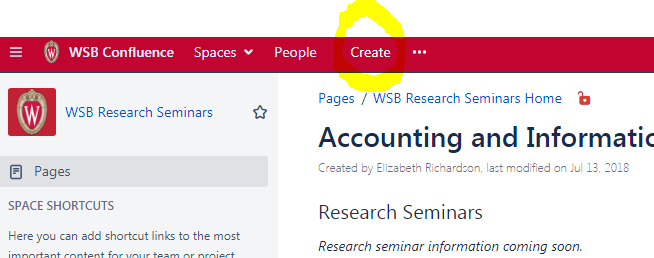
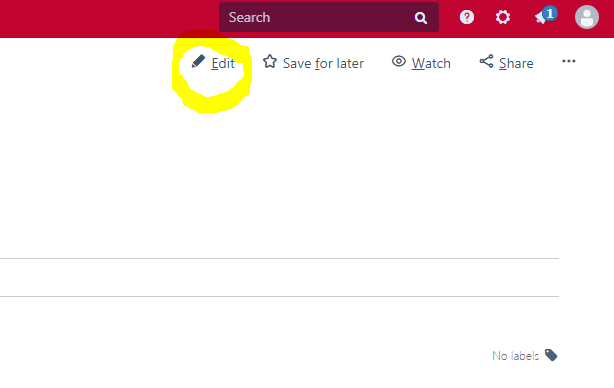
- Now your research seminar page will have the option to "Create" on the top red bar, as well as the option to "edit" on the right corner of each page.
Pictured below: the create button.
...
Pictured below: the edit button.
| Info | ||
|---|---|---|
| ||
If you do not see the "create" or "edit" links as show below, that means your account does not have editing permission for this page. Double check to make sure you are on the right page specific to your department. If you still don't have access, email webteam@wsb.wisc.edu with the link to the page you are trying to edit. |
...
| Anchor | ||||
|---|---|---|---|---|
|
...
- Go to the page you want to update.
- Click Edit, which should be in the top right corner.
- If the Edit button does not exist, you do not have permission to edit the page. Contact webteam@wsb.wisc.edu for access if needed.
- After making the changes, you can either click at in the bottom to update the page, which publishes it live, or close it, which will very bottom left corner, click:
- update to publish changes live
- or close to save a draft of your changes
- You can now view your new page on the left-hand list of pages within the Research Seminar's sitechanges.
...
| Anchor | ||||
|---|---|---|---|---|
|
Each Semester semester or Academic Yearacademic year, you'll likely need to create a new page. Follow the steps below.
- Make sure you are on your academic department's top page.
- Click on the “Create” button at the top red bar. (
Note: Clicking the “Create” button will automatically create a subpage below the page you are currently on, so make sure you are on the main department page.) Name the page by typing into the “Page title” section, the top line. The page should be named by Semester Year: Department Name.
You can now add paragraphs, tables, and tables links to your new page.
...
| Anchor | ||||
|---|---|---|---|---|
|
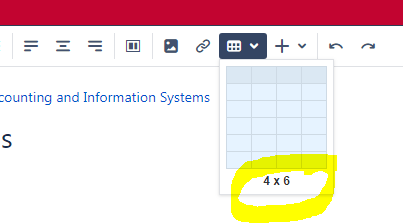
- Click the "Insert Table" button
- Choose the size of your table, based on the number of rows and columns (You can always add and remove rows after creating a table).
- Hover your mouse to the right until you have the number of vertical rows you need.
- Hover your mouse down until you have the number of horizontal columns you need.
- You should see the number of rows and columns you're creating (such as 4x6).
- Click to create
Once the table is inserted, text can be entered in each cell.
You can add or remove columns and rows from the table using the editing toolbar's second row of buttons.


...
| Anchor | ||||
|---|---|---|---|---|
|
...
- Highlight the text you wish to link
- Click the insert link button on the editing toolbar.
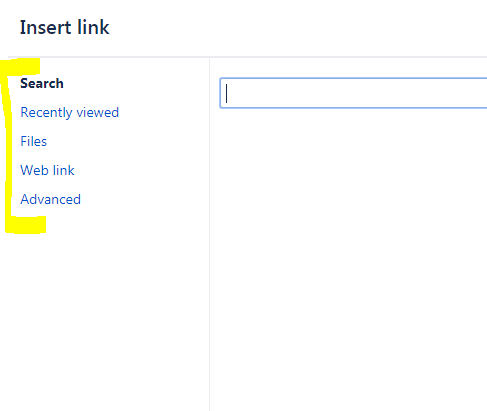
- A box will pop-up with multiple options:
- To link to a file, click "Files" and then "Browse" to browse to the file on your computer that you wish to attach and link to.
- To link To Link to a page within confluence, (for example another year's list of seminars), use the "Recently Viewed" or "Search" option, and find the page you wish to link to.To insert an external link, such.
- To link to an external web page, such as https://wsb.wisc.edu, click "Web Link" and then page the link into the "Address" field.
Pictured below: The insert link button on the editing toolbar.

Pictured below: the link pop-up box options:
| Info | ||
|---|---|---|
| ||
Files that are linked to become "attached" to the page you edited. You can manage attachments of a page by clicking the "..." on a page's upper right corner (next to "Edit", "Save for Later" "Watch" and "Share". |
...
Step Seven: Add Jump Links (Optional)
If you’d like to add a link that jumps down to a section on the same page, follow the steps below. (These types links of links are called "Anchor links" and also sometimes referred to as"Jump Links", or "In-Page" links).
Click on the line where you want the link to jump to. Do not highlight any text. You just need to make sure your cursor is where the link should "jump" to.
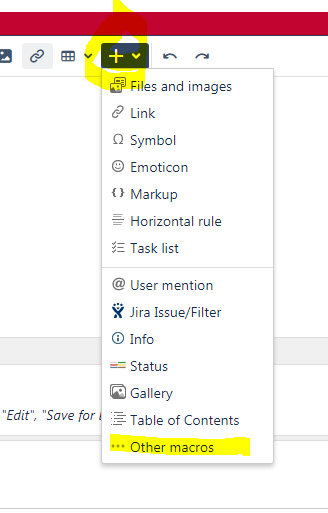
Click the Insert more content button in the toolbar, the plus sign, and select “Other macros”.
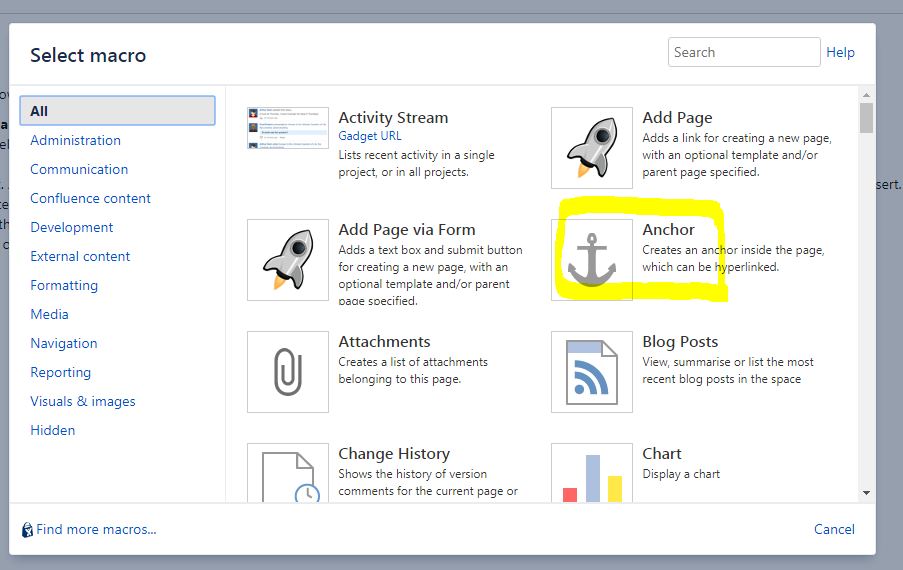
From the list of macros, select the “Anchor”.
In the Anchor Name field, type in the name of the anchor link you want. Anchor links are often the name of the header they are linking to, or some other key word associated with the section it links to. Then click Insert.
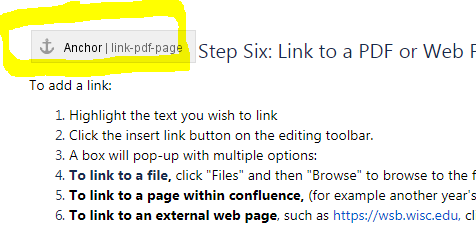
Once inserted, you should see a box that appears on the line you selected. This box only appears when editing a page, and is invisible on the live page.
Once you’ve added the Anchor, select the text that you want to link to the Anchor. Select the Insert Link button in the toolbar.
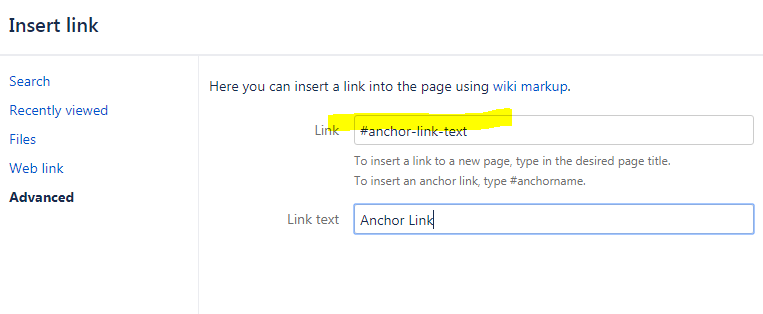
Select the Advanced tab and under link, type “#” followed by the name of the Anchor you want it to link to. Select Insert.
Pictured below: How to see the "Other Macros" option on the editing toolbar.
Pictured below: The "Anchor" macro.
Pictured below: What an anchor link looks like to an editor. This isn't visible on the page when outside of editing mode.
Pictured below: What it looks like when linking to an anchor link.
...
Step Eight: Add Photos with Text (Optional)
If you'd like to add photos and text, such as details of a speaker and their topic, you would do the following:
- Click the "Insert files and images" button on the editing toolbar.
- Click "Upload files"
- Find the image you wish to use (Please resize with an image editor before adding to allow your page to load faster).
- Click "insert" and you will now see your image on the page. You can move this image around as needed.
- Click on the image to see options to add a border.
- Add alt text to images - after you have your image on the page, click on the image, then click "properties" and add text describing the image.
...
Turning "Watching" Notifications/Emails Off or On
...