
-
Created by
 Erica McConnaughey, last updated by Mia Bentel on Jan 24, 2022
4 minute read
Erica McConnaughey, last updated by Mia Bentel on Jan 24, 2022
4 minute read
There are several individual folders for each part of the email process. They should all be organized the same way.
Emails> All > WSB
You can get to the list of emails by going to Assets> Emails then selecting “All Files” from the right sidebar.
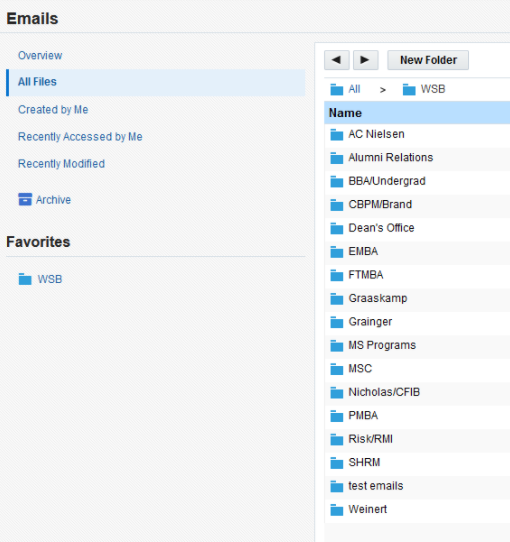
You will also see these folders when you save your email.
Organization: similar to how we’ve done in the past with sitecore, emails will be organized by the year and month of when the email is sent. You should save and organize your emails according to:
All>WSB>[your department]>[year]>[month]
If your department sends fewer than 15 emails a year, you do not need to organize by month.
The folders for the remainder of 2021 have been created for you, but you will be expected to create additional folders for future dates using the same structure.
If you have a lot of emails, you may want to create additional folders for organization by topic. As long as you’re consistent and communicate with other email creators in your department, you can do this in whatever way makes sense to your department.
Be careful not to save your emails into other department’s email folders. If you do by accident, please move the email to the correct folder right away to prevent confusion.
Images > All > WSB
You can get to the image library by going to Assets (or the pencil and paper icon)> Components> Images
You can also view the library when browsing for an image from the email editor.
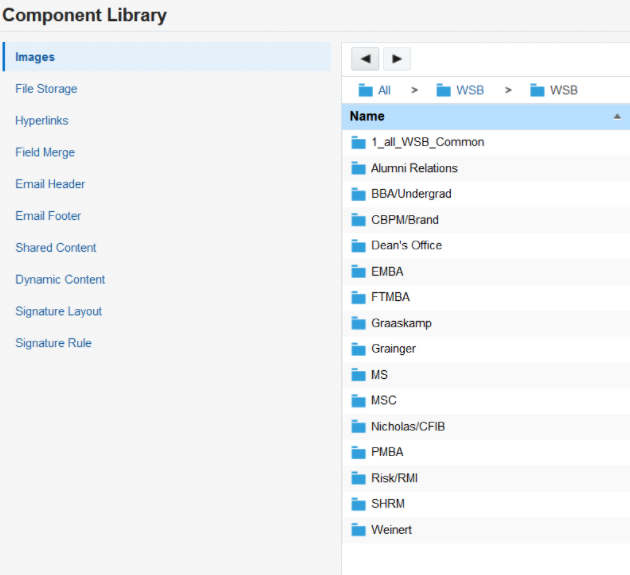
Organization: similar to how we’ve done in the past with sitecore, images will be organized by the year and month of when the email the image is in is sent. You should save and organize your images according to:
All>WSB>[your department]>[year]>[month]
If your department sends fewer than 15 emails a year, you do not need to organize by month.
The folders for the remainder of 2021 have been created for you, but you will be expected to create additional folders for future dates.
Additionally, each department has been given a “Common” folder which will be used to store anything that is used across multiple emails. We recommend creating additional subfolders in “Common” if you will be adding a lot of photos in that folder.
Note: you cannot delete images once you’ve uploaded them. If you have unwanted images taking up space, you can create a “delete” folder and move them there.
The WSB > 1_all_WSB_Common folder contains images that can be used across departments.
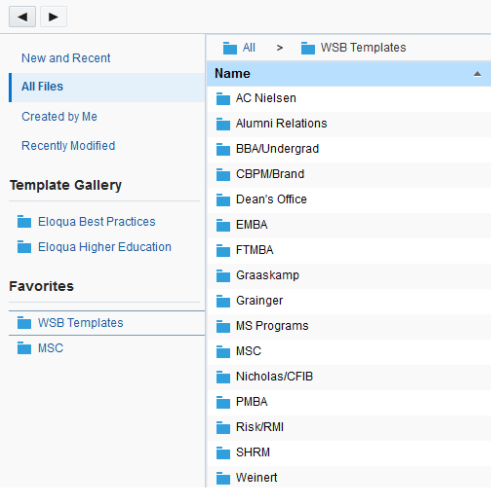
Templates> All (All Files) > WSB Templates
Where we store all our custom email templates. You will not edit this folder, but you will use it when you create an email and it prompts you to select a template.
Under WSB Templates, there will be a folder for each department. It is here that you can find custom templates for your department.
Note: You should not be creating emails without selecting one of these templates, as they have already been designed for accessibility, brand standards, and usability.
Campaigns> All (All Files) > WSB
Pretty much identical to the Email file structure:
All>WSB>[your department]>[year]>[month]
Individuals in each department are responsible for creating the folders necessary to follow this file structure.
Audience>Tools>Shared Lists>WSB
When you upload a list of contacts, it creates a Shared List.
Make sure to name your list clearly prior to clicking the upload icon (otherwise you'll have to rename it later).
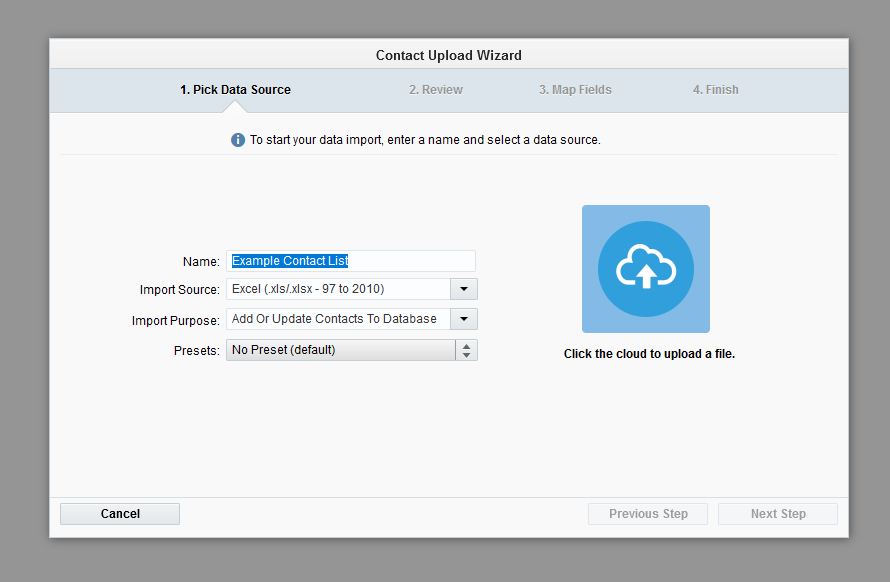
On Step 4 of the Contact Upload Wizard, make sure to select your department folder in the "Create in folder" dropdown. If you can't find your folder, at least select the "WSB" folder.
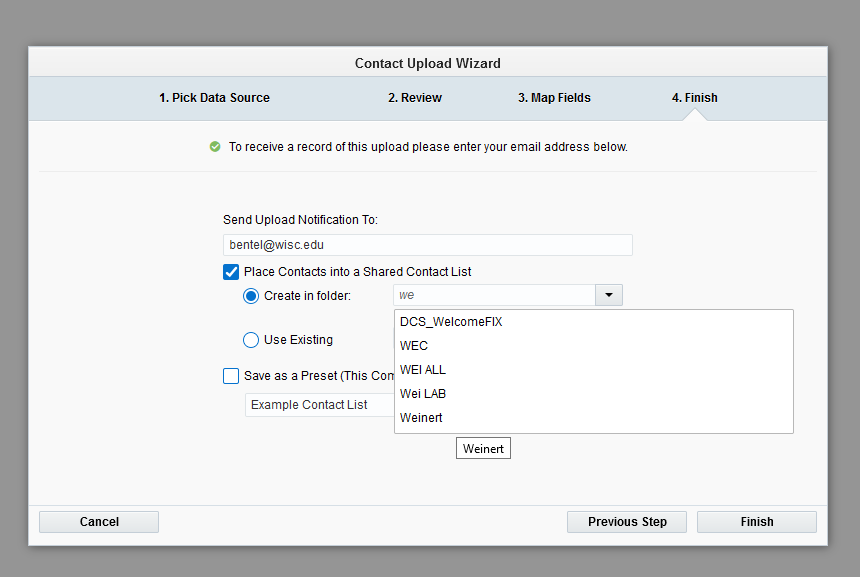
After you upload your contacts, you can find your shared list by going to Audience>Tools>Shared Lists>WSB and further organize them within your department folder as needed.
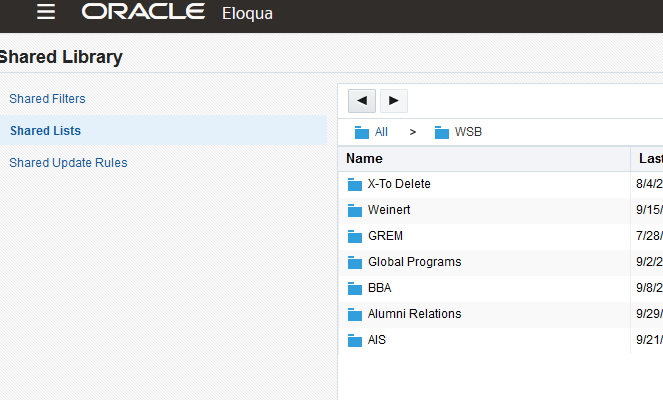
If you upload a new list every time you send an email, use the year>month structure. If you're reusing your lists, you can keep them in your main department folder, but make sure to name them clearly.
Benefits of Organized Folders
There are many benefits to keeping your emails organized. They include:
- Faster finding and reusing of previous emails.
- Easier updating and maintenance of your campaigns.
- Quicker clean up and deletion of outdated materials.
- Faster training and on-boarding